
Reviewed · TITO & YUGOSLAVIA TOURS
Communist Tour in Belgrade
Trg Republike pulls you into Belgrade fast. This tour strings together the city’s main power squares, memorial architecture, and the story of Tito and Yugoslavia, then carries you right into the Museum of Yugoslavia. You’ll spend the evening in Republic Square territory before shifting to Socialist-era landmarks and the museum’s big rooms.
What I like most is the way the route is built for understanding, not just photos. You hit tangible landmarks tied to real moments, like the NATO bombing in 1999, and you also get a satisfying 1 hour at the museum with Tito’s legacy in focus. Another big plus is the guide quality, with names like Stefan, Michael, and Milan praised for strong English and clear, balanced explanations.
The main thing to consider is timing. It starts at 3:00 pm and runs about 3 hours, including a trolleybus ride, so plan for a solid afternoon commitment rather than a quick stop.
In This Review
- Key highlights you should not miss
- Trg Republike to Tito’s era, why this tour feels like a timeline
- Tour basics: 3 hours, $24.03, and a small group in English
- Stop-by-stop route: Republic Square, union halls, parliament, and the scars of 1999
- Stop 1: Trg Republike and the big political symbols in public space
- Stop 2: Dom Sindikata, Socialist realism made for authority
- Stop 3: Nikola Pašić Square and the parliamentary building’s shifting role
- Stop 4: Kneza Miloša, the korzo promenade and the embassy corridor
- Stop 5: Generalštab, the Yugoslav General Staff and the damage that still shows
- Stop 6: Museum of Yugoslavia by trolleybus, then Tito in a museum setting
- Museum of Yugoslavia: Tito’s story, the House of Flowers, and why this stop matters
- What the guides do well, and why English delivery matters here
- Price and logistics check: is $24.03 actually good value?
- Who this Communist Tour is best for
- Practical tips for your afternoon in Belgrade
- Should you book this tour or skip it?
- FAQ
- How long is the Communist Tour in Belgrade?
- Where does the tour start and end?
- What time does the tour begin?
- Is the tour offered in English?
- What is included in the price?
- Are there admission tickets required for the other stops?
- How many people are in the group?
- Is the Museum of Yugoslavia visit long enough to see a lot?
- Can I cancel for free if my plans change?
Key highlights you should not miss
- A narrative route through Tito era symbols to 1990s trauma and democratic change
- Socialist realist architecture at Dom Sindikata and a seat of power at Nikola Pašić Square
- Kneza Miloša Street as a real-life promenade and an embassy-heavy corridor
- Generalštab, a post-war masterpiece still marked by NATO bombing damage
- Museum of Yugoslavia entry included, plus trolleybus transport to get you there
- English delivery and guides praised for fact-based nuance, plus book and documentary suggestions
Trg Republike to Tito’s era, why this tour feels like a timeline
Belgrade has a talent for mixing eras in the same view. On this tour, the story starts in Republic Square, one of the city’s central anchors, where the guide sets up what shaped Yugoslavia and how that influence showed up in public life. You are not wandering randomly, you are moving along a guided argument made of streets and buildings.
I especially like that the explanations are tied to specific themes, not just names. The stop at Trg Republike covers Tito-era youth symbolism, the Non-Aligned movement, the tensions that built up in the 1990s, the NATO bombing of Serbia and Montenegro in 1999, and the democratic changes that followed in the early 2000s. That arc matters because it helps you read the rest of the city with better eyes.
If you come in with even a light interest in modern Balkan history, this tour gives you handles for the bigger picture. And if you come in with no background, it still works, because you are shown where the story is actually visible.
More Tito and Yugoslav-era tours:
- Red Belgrade Communist Tour★ 5.0 · 78 reviews
- Architecture of New Belgrade – Brutalism Decoded★ 4.5 · 24 reviews
- NATO Bombing of Belgrade Historical Tour★ 5.0 · 17 reviews
Tour basics: 3 hours, $24.03, and a small group in English
This is a 3-hour group tour in English, priced at $24.03 per person. The group size caps at a maximum of 15 travelers, which usually makes questions easier and keeps the pacing from feeling chaotic.
It is also designed to be realistic in the middle of a day. You start at 3:00 pm at Trg Republike, and you end at the Museum of Yugoslavia, in front of the museum entrance. Most travelers can participate, and the start point is near public transportation, so you are not stuck figuring out a complicated meetup.
Two practical value points:
- Entrance to the Museum of Yugoslavia is included, which is often where people feel the budget pinch on tours like this.
- There is a trolleybus transfer included later in the route, so you do not have to guess your way across city blocks mid-story.
Stop-by-stop route: Republic Square, union halls, parliament, and the scars of 1999
You do not just see buildings, you learn how they functioned and what they were meant to communicate. The route is short on time, but it still covers a lot because each stop is chosen for a reason.
Stop 1: Trg Republike and the big political symbols in public space
Republic Square is the right first stop because it is a central place where ideas get staged. Here, the guide introduces the Tito phenomenon and connects it to public messaging. You also hear about the Youth relay baton and the Non-Aligned movement, both of which help explain Yugoslavia’s unique position during the Cold War rather than treating it like a simple satellite story.
Then the tour moves forward into the 1990s conflicts and the NATO bombing of Serbia and Montenegro in 1999, before reaching the democratic changes at the start of the third millennium. That might sound heavy for a walking tour, but the way it is framed gives you a timeline to carry with you.
Good to know: this stop is about 15 minutes, and there is no admission ticket needed.
Stop 2: Dom Sindikata, Socialist realism made for authority
Dom Sindikata, also known as the Trade Union Hall, is the kind of building that looks like it was designed to be remembered. It is described as a massive structure in socialist realism style, and the construction started in 1947, projected by Branko Petričić.
This is a useful stop because it teaches you how power used design. In socialist-era architecture, scale and form often did the persuading. Even if you are not an architecture nerd, you will likely notice how the building communicates seriousness and permanence.
This stop is also free to view, and it lasts about 15 minutes.
Worth putting on the shortlist while you plan Belgrade:
Stop 3: Nikola Pašić Square and the parliamentary building’s shifting role
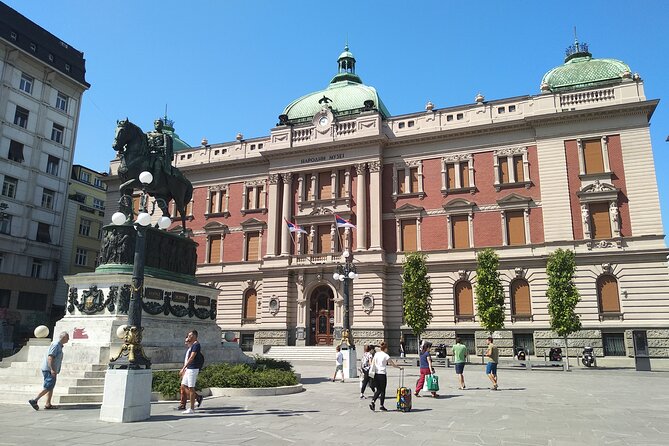
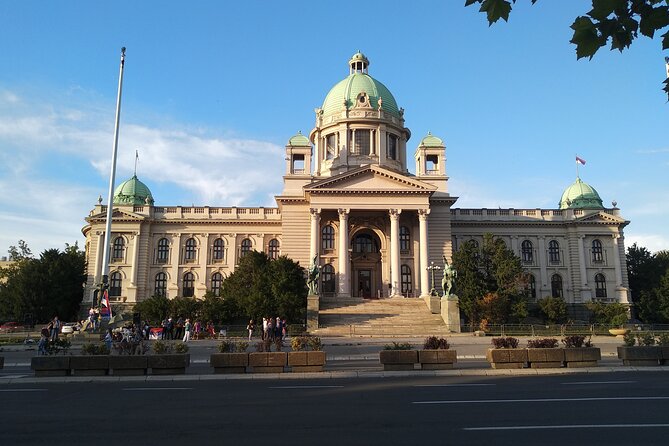
Next comes the House of the National Assembly of the Republic of Serbia, located on Nikola Pašić Square in downtown Belgrade. It is a landmark and a tourist attraction, but the most valuable angle is its role over time.
Between its completion in 1936 and 2006, it served as the seat of the Parliament of Yugoslavia and later the Parliament of Serbia and Montenegro. That detail matters because it shows continuity and change at the same physical site. You can stand in the same place and watch the political map rearrange itself.
Plan on about 15 minutes here, with free admission.
Stop 4: Kneza Miloša, the korzo promenade and the embassy corridor
Kneza Miloša Street is a change in texture, from buildings of institutional weight to a street people actually move through. It was the main city korzo, meaning a promenade, and today it acts as a major traffic artery.
What I like about this stop is that it adds a different kind of political context. The guide points out that the street holds national institutions and has the largest number of embassies in Belgrade. So instead of only thinking in Yugoslav-era terms, you start noticing how today’s diplomacy sits right inside the city fabric.
This is about 20 minutes and also free.
Stop 5: Generalštab, the Yugoslav General Staff and the damage that still shows
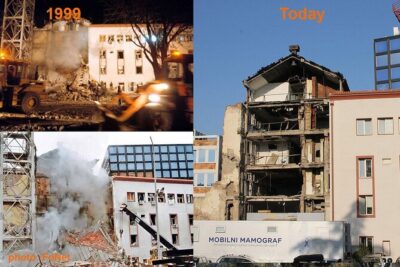
Generalštab is one of the stops that can hit you emotionally because the building carries evidence of 1999. It was the Yugoslav Ministry of Defence building, also known as the Yugoslav General Staff, and it is described as a post-war architectural masterpiece.
The difficult part is also the important part. It was bombed and heavily damaged during the NATO bombing of Yugoslavia in 1999. Even from outside, you will be reminded that history is not only in museums. It is in the shape of what was repaired, rebuilt, and left scarred.
This stop is about 15 minutes, admission free.
Stop 6: Museum of Yugoslavia by trolleybus, then Tito in a museum setting
From Generalštab to the Museum of Yugoslavia, the group takes a trolleybus ride, about 15 minutes. I like this transfer because it keeps you from burning time walking between story beats.
Once you arrive, the tour settles you into the museum for about 1 hour, and museum entry is included. This is where the tour’s themes come together in artifacts, exhibits, and a structured timeline.
Museum of Yugoslavia: Tito’s story, the House of Flowers, and why this stop matters
The Museum of Yugoslavia is a public history museum in Belgrade that covers the Kingdom of Yugoslavia and Socialist Yugoslavia, with a focused look at Josip Broz Tito’s life. This is not just a political lecture in room form. It is a history museum built around how people lived and how Yugoslavia presented itself across decades.
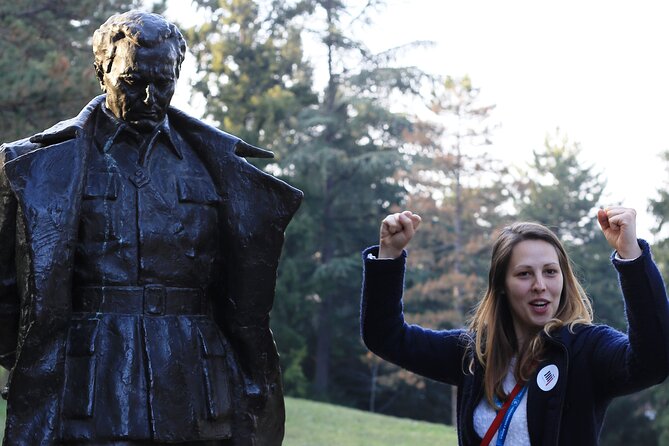
One reason this museum is so central is that the museum includes Tito’s grave, located in one of the museum buildings, the House of Flowers. That detail turns Tito from an abstract historical figure into a physical place tied to mourning, memory, and how nations curate legacies.
It is also one of Serbia’s busiest museums, with 120,000 visitors annually, described as the most visited museum in Serbia. Even if you do not care about crowd statistics, it signals something practical: the museum is set up to be understood by a wide range of visitors, not only experts.
Your visit is included, and it is timed as the tour’s anchor. If you want value, this is where your ticket money goes, since you also get the trolleybus ride without paying extra.
What the guides do well, and why English delivery matters here
This is not the kind of history tour where you want a vague “politics are complicated” shrug. The best guides on this route bring modern Serbian history into view with fact-based information and nuance, while staying objective in how they present distant and recent past.
In the feedback, guides like Stefan stand out for tackling a complicated topic with clarity and English strength. Another guide, Michael, is mentioned for being passionate and for knowledge of the transit system, which matters because you ride a trolleybus as part of the tour. Milan is praised for objective presentation, which is useful when the subject matter is emotionally charged.
For you, the real benefit is that you walk away with vocabulary and structure. You start connecting what you see in Belgrade today with what was promoted, fought over, and remembered through the 20th century and into the 2000s. That is how a short 3-hour tour turns into long-lasting context.
If you care about going further, Stefan is also noted for providing book and documentary recommendations when asked. That is the kind of extra value that makes a tour feel like a gateway, not a dead end.
Price and logistics check: is $24.03 actually good value?
At $24.03 per person, this tour is priced for short, focused storytelling. The main value question is whether you get enough “paid” parts to justify it. Here, you do.
You get:
- A professional tour guide
- Museum of Yugoslavia entrance included
- A trolleybus ticket included
- The route covers multiple major downtown landmarks with free viewing stops
Since the museum time is 1 hour and entry is included, you are not paying extra at the final stop. That is often where similar tours quietly add costs.
Two trade-offs to keep in mind:
- You are capped at about 3 hours total, so you will not get a slow, linger-everywhere style. It is built to move.
- The story includes difficult events like the 1999 NATO bombing, so if you prefer only light historical context, you might find the tone intense.
Still, if you want one efficient afternoon that improves how you read Belgrade, the price-to-time ratio is strong.
Who this Communist Tour is best for
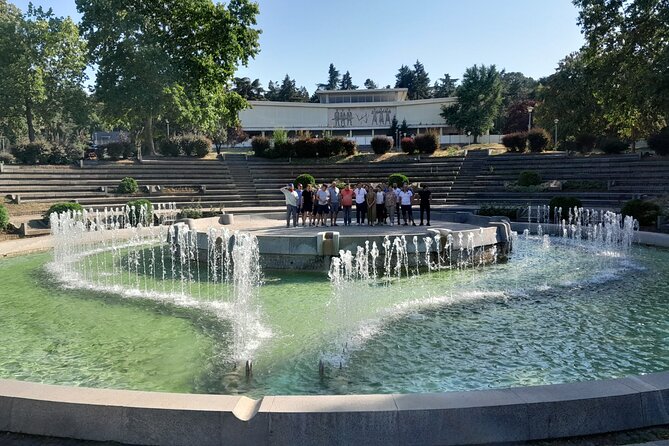
This works especially well for you if:
- You want a guided explanation of Yugoslavia and Tito era public life, not just sightseeing
- You like history that links buildings to events and ideology
- You prefer an English tour where the guide can handle nuance without getting lost
It is also a good fit if you like to travel with a plan. The route is not random, it is a carefully timed chain of places: Republic Square, Dom Sindikata, Nikola Pašić Square, Kneza Miloša Street, Generalštab, then the Museum of Yugoslavia.
If you already know a lot of Yugoslav history, you may still enjoy it because the focus is on how the story shows up in Belgrade’s streets. If you know very little, the guide structure helps you get oriented fast.
Practical tips for your afternoon in Belgrade
A few things will make this smoother:
- Wear comfortable shoes. You are doing a walking route with a short trolleybus transfer.
- Bring a light layer. Late afternoon weather can shift, and museums also have their own indoor temperature.
- Plan your next stop after the tour. The tour ends in front of the Museum of Yugoslavia, which is convenient if you want to extend your time there on your own.
Also, because the maximum group size is 15, you can usually ask questions without waiting through a long line of voices. Use that time if you want book or documentary recommendations from your guide.
Should you book this tour or skip it?
Book it if you want a compact way to understand why Belgrade looks the way it does, and why certain buildings carry emotional weight. The combination of Republic Square context, the socialist-era architectural stops, and the museum entry makes this more than a list of landmarks.
Skip it if you only want upbeat historical sightseeing, or if you cannot handle discussions that include the 1990s conflicts and the NATO bombing in 1999. This is an honest history route with real subject matter.
Overall, if you are in Belgrade for a short time and you want one guided experience that gives you clear structure, this is a smart use of a half-day.
FAQ
How long is the Communist Tour in Belgrade?
The tour lasts about 3 hours.
Where does the tour start and end?
It starts at Trg Republike, Belgrade, Serbia, and ends in front of the Museum of Yugoslavia.
What time does the tour begin?
The start time is 3:00 pm.
Is the tour offered in English?
Yes, it is offered in English.
What is included in the price?
The price includes entrance to the Museum of Yugoslavia, a trolleybus ticket, and a professional tour guide.
Are there admission tickets required for the other stops?
The tour notes free admission for the outdoor and other listed stops, while the museum entrance is included.
How many people are in the group?
The tour has a maximum of 15 travelers.
Is the Museum of Yugoslavia visit long enough to see a lot?
The museum stop is 1 hour.
Can I cancel for free if my plans change?
Yes, free cancellation is available, with the policy allowing a full refund if you cancel at least 24 hours in advance.
Newly written up in Belgrade
- Private Belgrade Street Art Tour
★ 5.0 · 1 review - The best of Novi Sad walking tour
★ 5.0 · 1 review - Tara National Park, Mokra Gora and Zlatibor
★ 5.0 · 1 review - Zasavica Bike Tour
★ 5.0 · 1 review - Discover Belgrade’s most Photogenic Spots with a Local
★ 5.0 · 1 review - Private Serbian Food Cooking Experience in Belgrade with Meal
★ 5.0 · 1 review - Topola: Royal Dynasty Half Day Tour from Belgrade
★ 5.0 · 1 review
Tito & Yugoslavia Tours, compared.
Architecture of New Belgrade – Brutalism Decoded
Read our review →

More Serbia tours of this kind