
Reviewed · TITO & YUGOSLAVIA TOURS
Architecture of New Belgrade – Brutalism Decoded
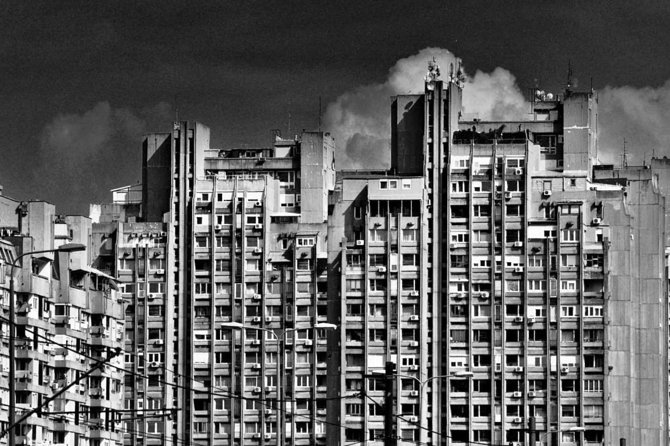
Concrete tells a story in New Belgrade. I love how this tour gives you an in depth look at five brutalist landmarks, and I also like the way the guide ties the buildings to everyday life and political context, not just style.
One catch: the pace is brisk. You get short, focused visits of about 15 to 20 minutes each, so if you want lots of quiet time inside, you might wish for more.
In This Review
- Key Highlights You’ll Care About
- Why New Belgrade Brutalism Feels Human, Not Just Concrete
- Meeting at Ušće: Museum of Contemporary Art’s Marble vs Socialist Expectations
- Park Prijateljstva: Peace and the Non-Aligned Movement in Tree Form
- Drive-By on the Government Building: A Political Timeline in Concrete
- Genex Tower at Narodnih heroja 45: The Western City Gate
- Sava Center: A Late 1970s Congress Giant That Still Works
- Primary School Laza Kostić in Block no. 23: Concrete Expressionism as Daily Life
- Price, Timing, and Logistics: Is It Worth 86.42?
- Who Should Book This Tour (and Who Might Skip It)?
- Should You Book Architecture of New Belgrade: Brutalism Decoded?
- FAQ
- Where does the tour start?
- How long is the Architecture of New Belgrade tour?
- Is the tour private?
- What language is the tour offered in?
- Are admission tickets included?
- What is the cancellation policy?
Key Highlights You’ll Care About
- Five stops across New Belgrade, with time to see how brutalism changes from museum to tower to housing
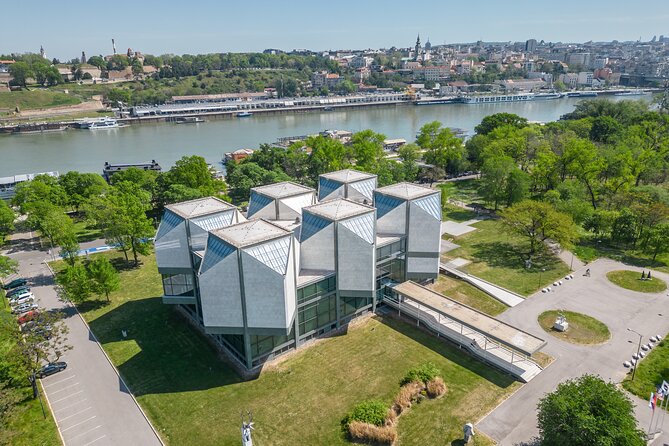
- Museum of Contemporary Art at Ušće shows modernist volumes and marble facades that break socialist expectations
- Park Prijateljstva connects directly to the Non-Aligned Movement and the 1961 peace-tree story
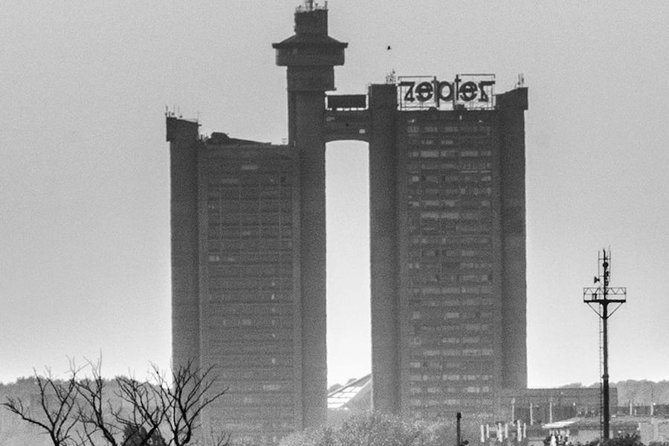
- Genex Tower (Narodnih heroja 45) gives you a close look at the 30 floor Western City Gate and its brutalist credentials
- Sava Center and Block no. 23 make the architecture feel practical, with interiors and community spaces still in use
- Private, English-led format, so you can ask questions instead of watching from the back
Why New Belgrade Brutalism Feels Human, Not Just Concrete
Brutalist buildings can sound cold on paper. On this tour, that stereotype gets challenged fast, because the guide keeps pulling you back to what the spaces are for.
I like that the experience is not only about shapes and materials. You also get the human angle, including how people lived in the housing blocks during the 1960s, 1970s, and 1980s, and how things felt less comfortable in the 1990s. That kind of context changes the way you see big concrete forms, from monument to workplace, school, and home.
You’ll also notice how politics sits right inside the architecture. From the museum’s marble contrast to the Non-Aligned Movement peace symbolism in the park, you get a sense that design choices were never neutral. Even the quick drive-by of a major government building helps stitch together the YU political timeline, including the shift away from Stalin while construction was underway.
One more practical thing: because the tour is private, you can steer your attention. If you care more about urban planning, you’ll get pushed toward the housing block and school. If you care about iconic silhouettes, you’ll spend extra focus on the tower and congress center.
More Tito and Yugoslav-era tours:
- Red Belgrade Communist Tour★ 5.0 · 78 reviews
- Communist Tour in Belgrade★ 4.5 · 19 reviews
- NATO Bombing of Belgrade Historical Tour★ 5.0 · 17 reviews
Meeting at Ušće: Museum of Contemporary Art’s Marble vs Socialist Expectations
The tour starts right in front of the Museum of Contemporary Art at Ušće, so you’re not hunting around. Expect about 20 minutes here, and there’s a key detail that sets the tone for the whole route.
The museum’s 1960s modernist volumes look designed for display and debate. Then the facades throw a curveball: precious marble fronts that contradict the typical expectation of what socialist architecture is supposed to look like. The guide uses that contrast to show how a single building can carry competing messages, style goals, and political assumptions.
One practical note. Admission to the museum is not included in the tour. If you want to go inside, you’ll need to budget that ticket separately and arrive with enough time. If your goal is mainly exterior architecture, the stop is still worthwhile, because the facades and overall form are the story.
If you’re coming from another part of Belgrade, arriving a few minutes early helps. Ušće is where the tour’s pacing begins, and you’ll want to start on time to keep the rest of the route feeling relaxed.
Park Prijateljstva: Peace and the Non-Aligned Movement in Tree Form
Next you head to Park of Friendship, known as Park Prijateljstva. This stop is quick, about 15 minutes, and it’s free of separate admission fees.
This is where the architecture tour becomes a political geography lesson without turning into a lecture. The park was founded in 1961 in Belgrade, when heads of state planted trees as a symbol of peace. The tour connects that moment to the Non-Aligned Movement, described as a group of 120 countries.
What I like about this stop is that the symbolism is physical. You’re not just reading about diplomacy. You’re standing in a place made from the idea that peace can be grown, and you can feel how the meaning sticks to the landscape and the design.
Because it’s a short stop, you won’t have time to wander forever. Use the moment to look for how the park’s layout guides movement and how people naturally use it. Even if you’re not into parks, you’ll still get the bigger point: architecture and urban design are often where political values get translated into everyday space.
Drive-By on the Government Building: A Political Timeline in Concrete
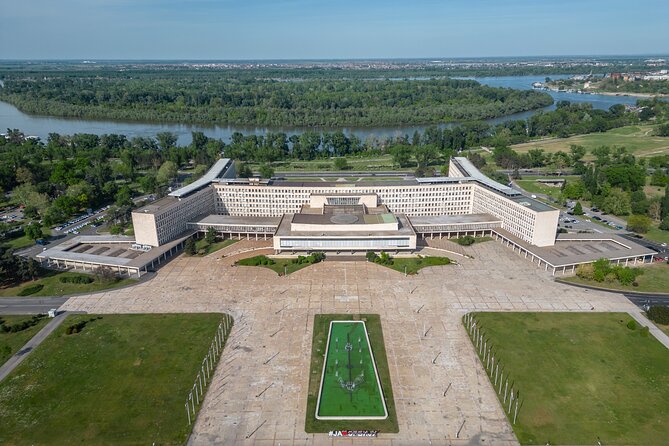
After the park, the tour includes a drive-by of a huge government building. There’s no long stop here, but it matters, because it helps anchor what you’re about to see later.
You get a view of the building as a monument to an earlier phase of YU politics. The guide also points out that it experienced the switch away from Stalin while it was under construction. That single detail adds weight to the buildings you’ll see later in the route, because it frames architecture as something shaped by power shifts mid-project, not just by abstract taste.
If you’re someone who likes context, this is a good bridge moment. If you prefer strictly walking and close-up photography, think of this segment as the “chapter heading” before the big icon shots.
You’ll likely notice the contrast in scale and intent. Even from a passing angle, government architecture tends to communicate authority differently than cultural buildings or housing blocks. That contrast is part of the lesson.
Genex Tower at Narodnih heroja 45: The Western City Gate
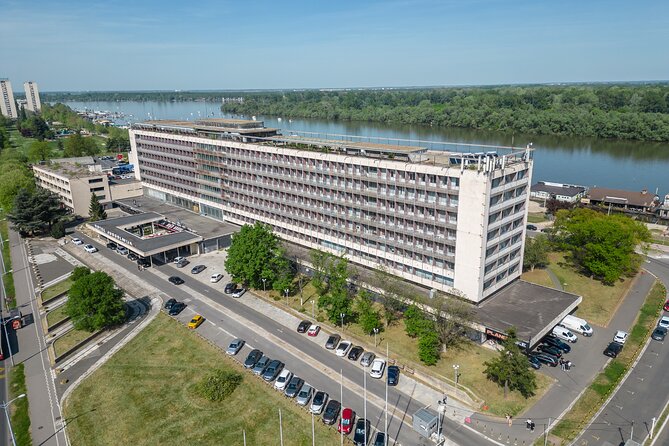
Then you get the close-up at Narodnih heroja 45. This is where the tour gets very photogenic.
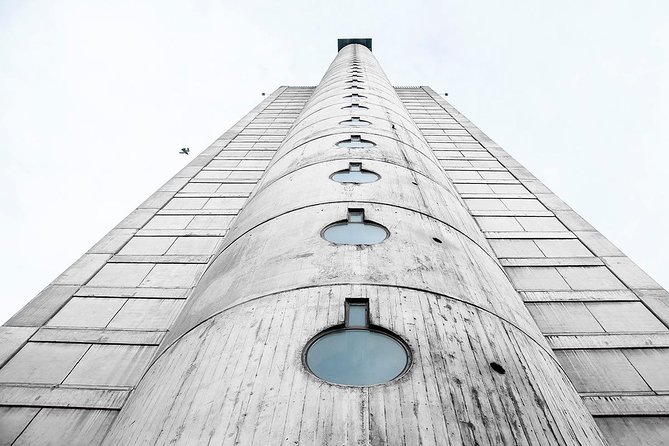
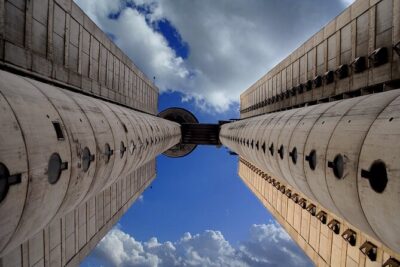
The star is Genex Tower, also called the Western City Gate of Belgrade. It’s a 30 floor structure that has become one of those buildings people talk about instantly, because it’s dramatic enough to win Instagram love while still being serious architecture. The tour explains it as a brutalist example that entered international architecture reviews, and it also gets an extra bragging point: it was built about 40 years ago and is described as the first smart building in the Balkans.
Those claims matter, but what you really get out of this stop is how you learn to read brutalism with your eyes. You’re not just looking at a tower. You’re looking for how the building’s massing and structural logic project power, identity, and modernity.
This stop is about 20 minutes, and admission is free. Use that time to walk around if the guide allows it, and try different angles. Even a small change in your viewpoint helps you see how the tower sits against the surrounding city blocks.
Also, plan to be ready for photos. If you arrive with your phone batteries charged and you’re wearing comfortable shoes, this is one of the easiest stops to enjoy fully.
Worth putting on the shortlist while you plan Belgrade:
Sava Center: A Late 1970s Congress Giant That Still Works
Your final architecture stop is the Sava Center, a gigantic congress center built at the end of the 1970s, described as achieved in record times. The guide also frames it as the first building of that type in this part of Europe, which helps you understand why it became a reference point.
You get about 15 minutes here, with no separate admission fees. The most useful part is not just the size. It’s the claim that the building is still in function and includes surprisingly well designed interior solutions that seem fresh even after 40 years.
That is a big deal if you tend to think of older modern buildings as outdated. Here, the tour pushes you to look for details that make a structure live well over time, like practical indoor layout and design choices that people still benefit from today.
Even with only a short stop, you can get a sense of how public buildings earn their reputation. They do not last because they look impressive from one angle. They last because the interior space keeps doing its job.
When you finish this stop, the tour ends at Sava Center, address Milentija Popovića 9, Beograd 11000.
Primary School Laza Kostić in Block no. 23: Concrete Expressionism as Daily Life
If you want the tour to feel less like a photo shoot and more like a real understanding of the city, don’t rush the last stop.
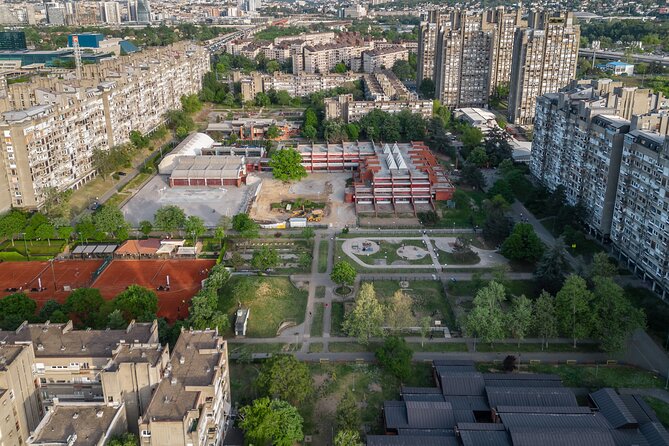
Inside Block no. 23, you visit a primary school called Laza Kostić. This area is described as the most representative public housing project, and it uses concrete expressionism, again keeping the theme of design as a way of organizing daily life.
The tour highlights a very specific idea: this concept aimed to provide everything for the inhabitants. It includes apartment buildings, a school, a kindergarten, sport courts, and even a mini shopping mall. In other words, you’re looking at urban planning as a system, not just individual buildings.
Then the guide adds the part that makes this stop memorable: personal stories about life in the blocks during the golden decades of the 1960s, 1970s, and 1980s, plus the contrast of how things were not so great in the 1990s. That human layer helps you see why architecture matters to people who are raising kids, buying groceries, and spending afternoons in sports spaces, not just to architecture fans.
This stop is about 15 minutes and is free of admission. If you’re interested in how cities function, it’s the best place on the route to ask questions. Look at it like a neighborhood model. You’ll understand New Belgrade brutalism as infrastructure for ordinary life.
Price, Timing, and Logistics: Is It Worth 86.42?
At $86.42 per person for about two and a half hours, the value comes from two things: the number of major stops and the private format.
You visit five buildings, plus you get that drive-by of a large government building. That is a strong ratio for a short time in a single area. Also, admission fees are not required for most of the route. The only place where admission is specifically listed as not included is the Museum of Contemporary Art at Ušće. Park Prijateljstva, Genex Tower, Sava Center, and the primary school stop are all described as free for admission.
So the “all-in” cost is likely to be close to the tour price unless you decide to add museum entry time.
Timing is the tradeoff. Each stop is intentionally brief, with most at 15 minutes and Genex Tower at about 20. That means the tour works best when the guide connects the dots fast and keeps the stories moving.
There is one caution to consider. Not every tour experience will feel equally emotional or detailed, and if you’re expecting long time at each site or deep interior access, the pace might feel like you saw highlights only. If you know you want slow, quiet, and thorough, plan extra time on your own after the tour, especially near the museum and the tower.
Who Should Book This Tour (and Who Might Skip It)?
This is a great fit if you like architecture with a story. The strongest version of this experience is when the guide is punctual and pulls together both the design details and the everyday human life behind them.
It also suits travelers who want to see New Belgrade off the typical sightseeing loop. Five stops concentrated in one theme means you get a sense of how the district thinks, not just how it looks.
You should consider a different plan if your priority is interior visits at length. The tour stops are short by design, and only the museum has an admission ticket noted as not included. If what you really want is a museum crawl or long stays indoors, this might not match your style.
One more fit check. Because it’s a private tour in English, it’s easy to ask for emphasis, like how a brutalist landmark relates to politics or how the housing blocks were designed to handle everyday routines. That back-and-forth is a big part of the value.
Should You Book Architecture of New Belgrade: Brutalism Decoded?
I’d book it if you want a smart, structured way to understand brutalism in Belgrade. The route makes the subject practical: marble on a modernist museum, diplomacy as trees in Park Prijateljstva, a political drive-by that sets context, the dramatic Genex Tower, the still-working Sava Center, and the lived-in logic of Block no. 23 and the school.
If you’re the type who likes architecture best when it’s tied to real life, you’ll leave with stories you can actually picture. If you hate rushed pacing, or you only enjoy architecture when you’re inside for a long time, you might feel shortchanged.
For most people who enjoy design and context, this tour is a good use of a couple hours. It gives you a coherent theme, five anchor buildings, and enough human perspective to make the concrete feel personal.
FAQ
Where does the tour start?
You meet your guide in front of the Museum of Contemporary Art at Ušće, address Ušće 10, Beograd, Serbia.
How long is the Architecture of New Belgrade tour?
The tour lasts about two hours and 30 minutes.
Is the tour private?
Yes. It is a private tour/activity, so only your group participates.
What language is the tour offered in?
The tour is offered in English.
Are admission tickets included?
Admission ticket details vary by stop. The Museum of Contemporary Art at Ušće has admission not included, while the Park of Friendship, Genex Tower area, Sava Center, and the Primary School Laza Kostić stop are listed as free of admission.
What is the cancellation policy?
You can cancel for free up to 24 hours in advance of the experience for a full refund. Cancellation cut-off is based on local time.
Newly written up in Belgrade
- Private Belgrade Street Art Tour
★ 5.0 · 1 review - The best of Novi Sad walking tour
★ 5.0 · 1 review - Tara National Park, Mokra Gora and Zlatibor
★ 5.0 · 1 review - Discover Belgrade’s most Photogenic Spots with a Local
★ 5.0 · 1 review - Zasavica Bike Tour
★ 5.0 · 1 review - Private Serbian Food Cooking Experience in Belgrade with Meal
★ 5.0 · 1 review - Topola: Royal Dynasty Half Day Tour from Belgrade
★ 5.0 · 1 review
Tito & Yugoslavia Tours, compared.

More Serbia tours of this kind